
Why This Matters
Risksheet AI Assistant addresses practical safety analysis challenges rather than pursuing technological novelty for its own sake. Key capabilities include reusing past FMEA knowledge, achieving consistent risk ratings, accelerating analysis timelines, linking risks to requirements and controls, and delivering auditable AI recommendations tailored to engineering workflows.
Introduction
The tech industry faces pressure to integrate AI everywhere. However, Nextedy prioritized solving genuine problems over demonstrating capabilities. FMEA’s core difficulties stem from human collaboration and consistency challenges rather than computational limitations.
The FMEA Grind: Why a Powerful Method Feels Painful
Brainstorming Bottleneck — Identifying failure modes and root causes consumes approximately 30-40% of the total effort in analysis work. Teams struggle to recall lessons from previous projects, resulting in inconsistent terminology that prevents pattern recognition and knowledge transfer.
Subjectivity Problem — The methodology depends heavily on subjective judgment when assigning Severity, Occurrence, and Detection ratings. Different teams evaluating identical failures produce divergent scores, undermining RPN reliability.
Disconnect from Implementation — FMEA frequently functions as a static compliance document rather than a living tool, creating a gap between theoretical analysis and product reality.
How the AI Assistant Provides Structured, Contextual Assistance
Risksheet AI Assistant integrates into existing workflows with contextual understanding of analysis types (HARA, DFMEA, PFMEA). Three primary functions address identified challenges:
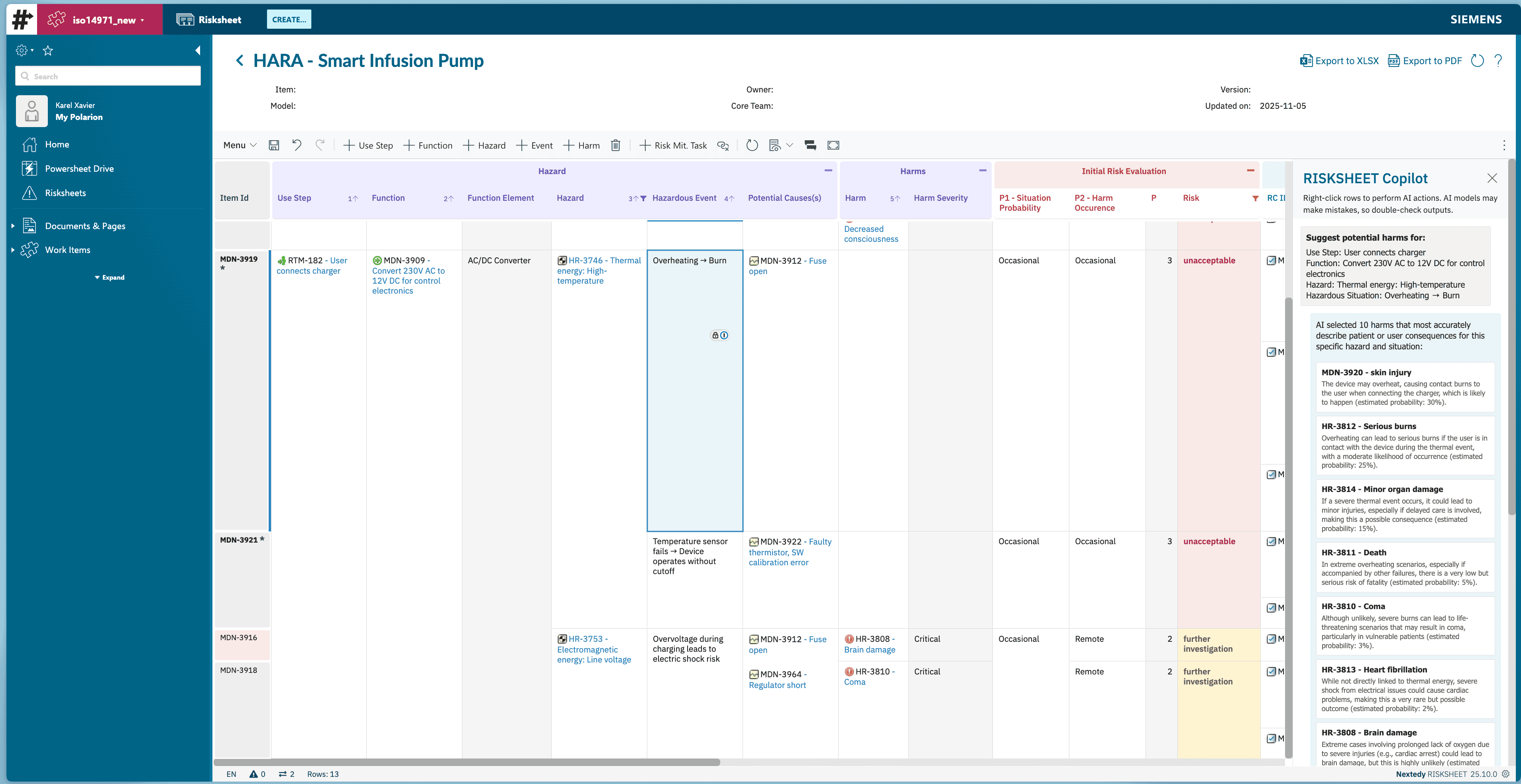
1. Resolving Inconsistency and Brainstorming Delays
The AI Assistant functions as institutional memory by suggesting potential causes for given failure modes from existing project knowledge bases, enforcing terminology consistency and enabling data reusability.
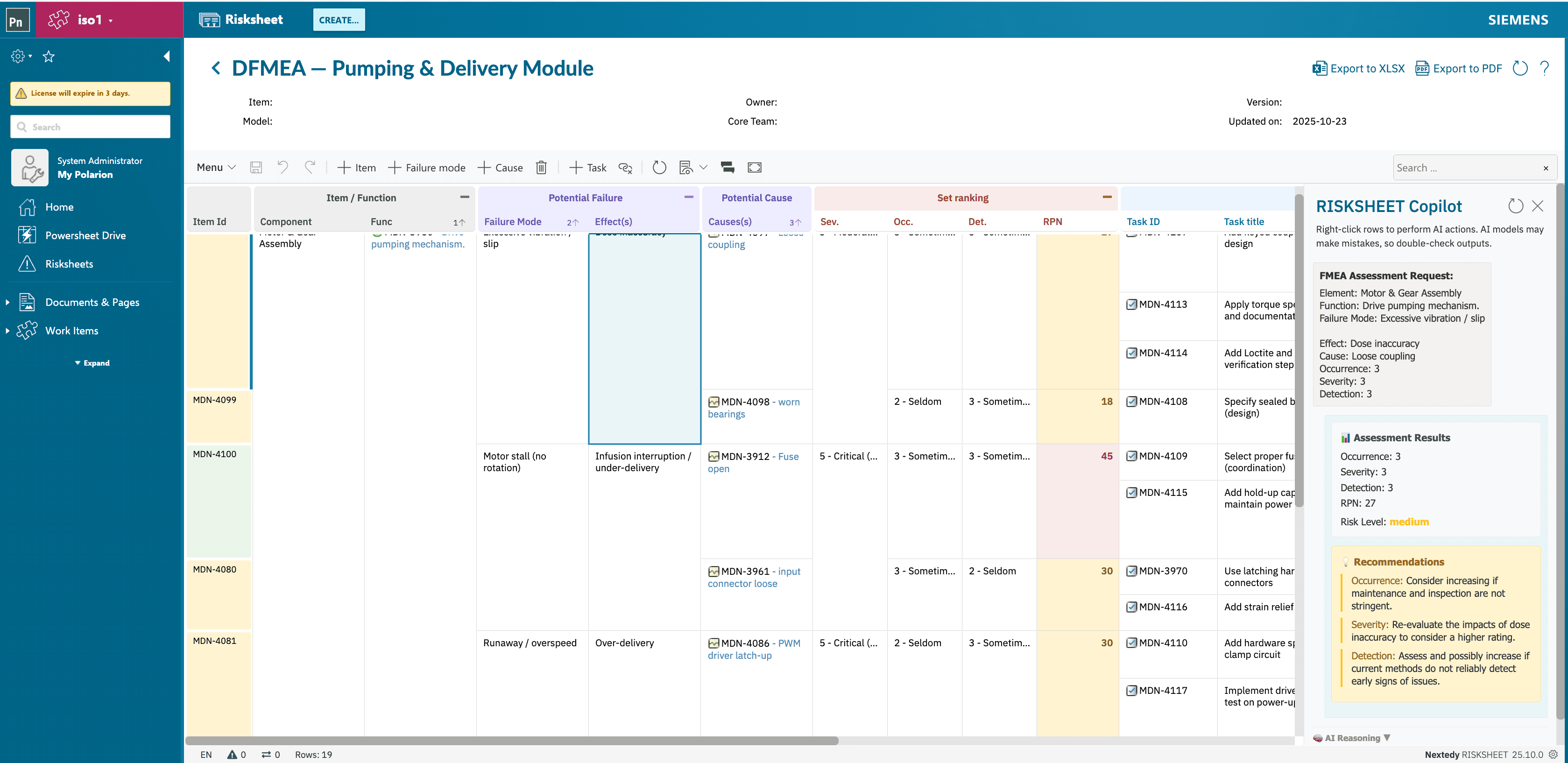
2. Adding Objectivity to Ratings
Through FMEA Assessment functionality, the AI Assistant delivers independent, AI-driven evaluation of risk ratings based on contextual information — a “second opinion” that helps teams identify bias and move toward defensible, consistent scoring.
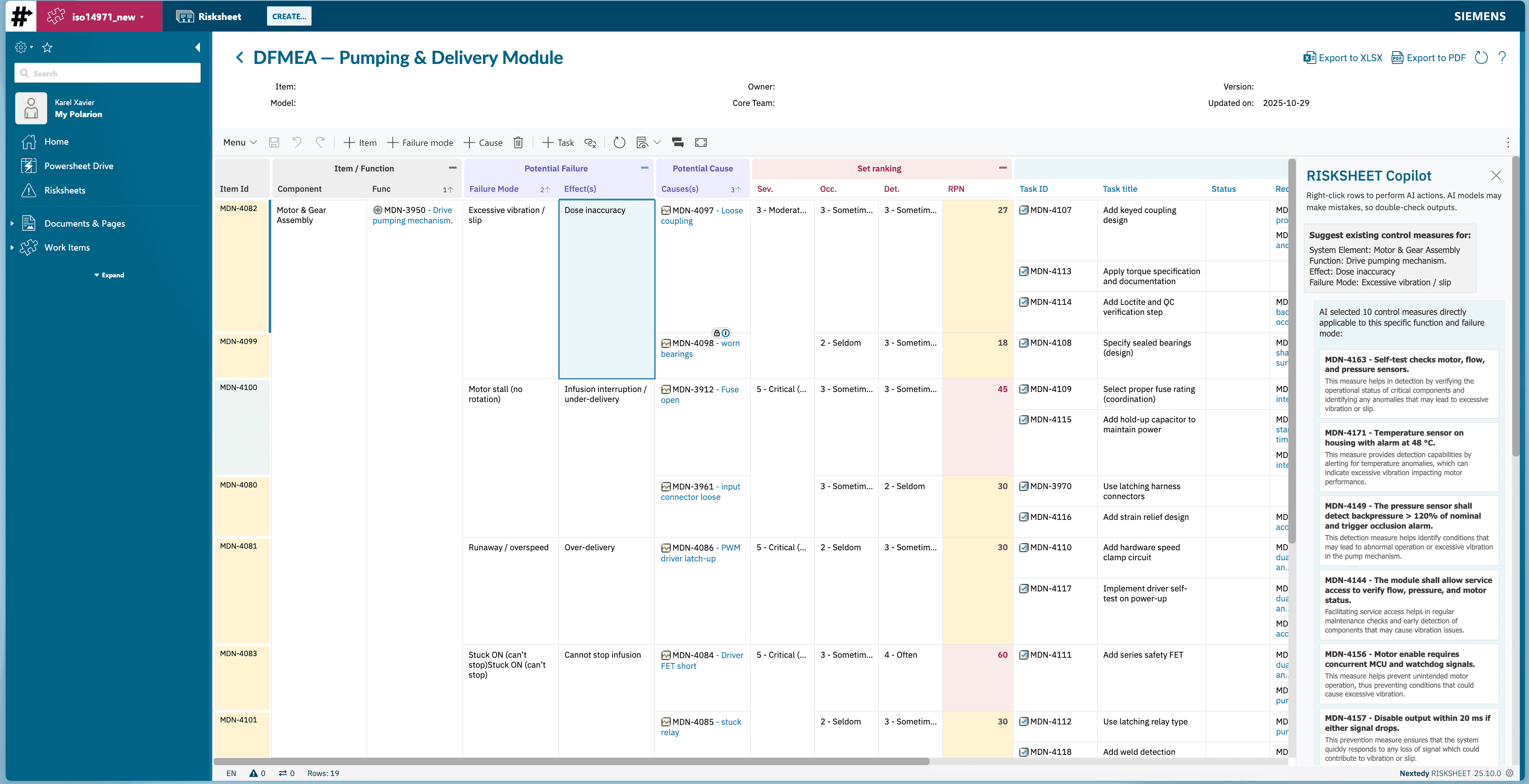
3. Grounding Analysis in System Reality
The AI Assistant suggests existing controls and mitigation measures from organizational requirements databases, linking failure modes to specific design controls or verification testing.
Validated for Trust, Not Rushed for Hype
Nextedy emphasizes validation over rapid deployment. Working with select organizations allows refinement of suggestions, enhancement of reasoning processes, and seamless workflow integration.
Join Us in Shaping the Future of Safety Analysis
Risksheet AI Assistant represents an initial step toward transforming FMEA from a subjective exercise into a data-driven engineering discipline. Interested organizations are invited to contact Nextedy regarding validation program participation and demonstrations.