
In safety-critical industries, cybersecurity and functional safety cannot operate in isolation. Threats affecting connected vehicles, medical devices, and industrial systems represent safety issues alongside IT concerns.
Standards including ISO/SAE 21434 require structured Threat Analysis and Risk Assessment (TARA), integrated with system requirements and mitigation strategies. However, many organizations continue managing TARA through disconnected spreadsheets and isolated tools rather than incorporating it into their engineering workflows.
What is TARA?
TARA (Threat Analysis and Risk Assessment) represents a structured methodology outlined in ISO/SAE 21434 designed to identify cybersecurity threats, evaluate their potential impact and likelihood, and establish appropriate protective measures.
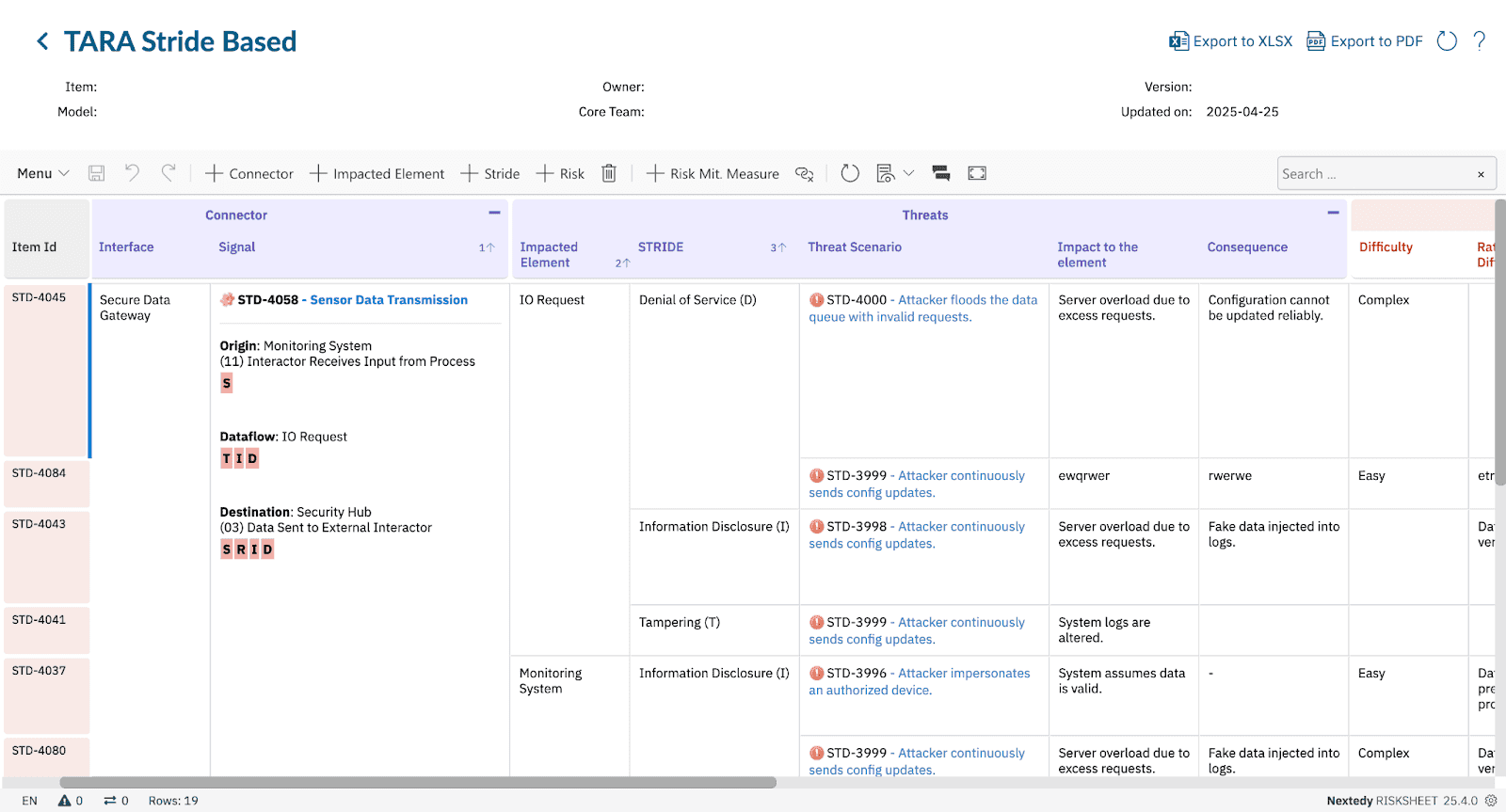
When executed within Polarion using Nextedy Risksheet, TARA becomes traceable, auditable, and directly connected to requirements, safety objectives, and verification activities.
Why TARA Must Live Alongside Requirements
1. Cybersecurity Risks Are Requirements Risks — Identified threats generate requirements for secure protocols, hardened interfaces, authentication mechanisms, and monitoring capabilities. Risksheet integrates seamlessly — each cybersecurity threat becomes a Polarion artifact, directly tied to the requirement it influences.
2. Standards Demand Traceability — ISO/SAE 21434 mandates complete traceability from threat identification through mitigation to verification activities. Risksheet embeds TARA artifacts within Polarion, establishing the evidence chains regulatory auditors require.
3. Cybersecurity Is Not Static — Threat environments continuously evolve. Risksheet maintains active TARA assessment — automatic recalculation of risk scores (including CVSS-style metrics) prevents frozen, outdated documentation.
4. Collaboration Across Teams — Cybersecurity extends beyond individual roles, encompassing safety engineers, architects, testers, and compliance managers. Risksheet’s spreadsheet-like interface within Polarion enables cross-disciplinary teamwork on unified data.
How Risksheet Brings TARA Into the Lifecycle
TARA Methodology Inside Polarion – Identify assets, threats, attack paths, and vulnerabilities while calculating exposure, impact, and feasibility within the platform
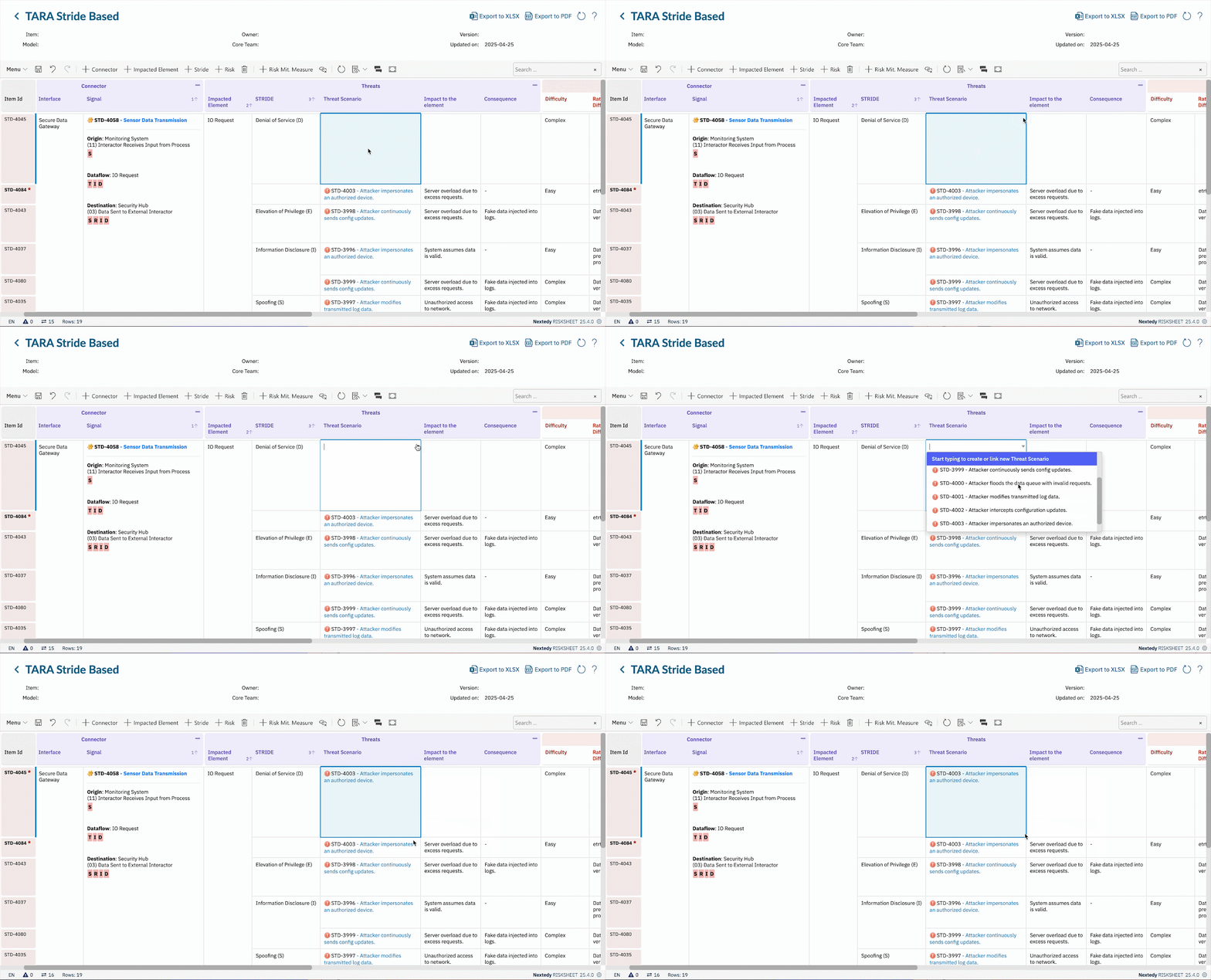
Link Threats to Safety & Requirements – Map threats to safety goals, hazards, and system requirements
Automated Metrics & Formulas – Apply CVSS-style scoring or custom formulas for consistent risk quantification with instant recalculation
Full Traceability Chain – Maintain unbroken evidence trails from threat through requirement, mitigation, and test case
Audit-Ready Outputs – Generate customized PDF reports with baselines and revision comparison functionality


Unique Advantage: Aligning Cybersecurity With Functional Safety
Organizations frequently manage functional safety (ISO 26262, ISO 14971) and cybersecurity (ISO/SAE 21434, IEC 62443) as separate disciplines. Risksheet uniquely aligns TARA with FMEA, HARA, and safety risk assessments, delivering a single source of truth for safety and security risks, consistent methodologies, shared collaboration, and reduced audit burden.
Conclusion
Nextedy Risksheet transitions cybersecurity risk management from isolated spreadsheets into integrated ALM systems, uniting TARA with requirements, safety considerations, and regulatory compliance. In connected, safety-critical systems, security fundamentally equals safety.