When a product gets AI, its maker has to answer three questions. Is the AI function high-risk under the EU AI Act? How do we meet each requirement that applies, and where is the proof? And what can go wrong because the function uses AI? Most teams answer them in three different places: a classification memo, a compliance spreadsheet and a risk register.
Nextedy AI Compliance answers all three in one Siemens Polarion project with Nextedy POWERSHEET. AI functions, regulatory requirements, measures, AI requirements, tests, test records and AI risks are all work items, linked to each other.
Watch the walkthrough (4 min):
A product that gets AI
The example is release 2.0 of a Remote Monitoring App that adds three AI functions. A Motor Anomaly Detector on the gateway watches motors and can request a protective stop. An Alarm Triage Ranker orders alarms on the dashboard. A Support Assistant answers questions in the mobile app. They do not carry the same obligations, and the AI System Inventory records why: each function's answers to the questions of the Act and the class that follows from them.
The detector can stop a machine and keeps adapting to each motor in operation. That makes it a safety component under Art. 6 of the AI Act as amended by the Digital Omnibus, Regulation (EU) 2026/1744, and high-risk through the Machinery Regulation. For AI in such products the requirements apply from 2 August 2028.
Every requirement, how it is met, and the proof
The Compliance Matrix lists the requirements of three sources in one sheet: the EU AI Act, the AI-related requirements of the Machinery Regulation (EU) 2023/1230, and the clauses and Annex A controls of ISO/IEC 42001. For each one it shows the compliance status, the measures that meet it, and a check that flags a status that does not match the evidence.

A measure alone is not evidence. So each measure is covered by AI requirements, written as shall statements: the validation dataset is kept apart from training, a model version is released only with a recall of at least 98 % for stop-relevant faults. Each AI requirement is verified by a test, and each test has its test records from a Polarion test run. The Evidence view follows that chain from the article of the Act to the latest result.

Art. 9 is met by doing the risk assessment
One requirement is different. The risk management system of Art. 9 is met by running the AI risk assessment, so its line in the matrix reads the state of that assessment live: how many AI risks there are, how many are open and how many are not acceptable yet, with a link straight into the sheet.
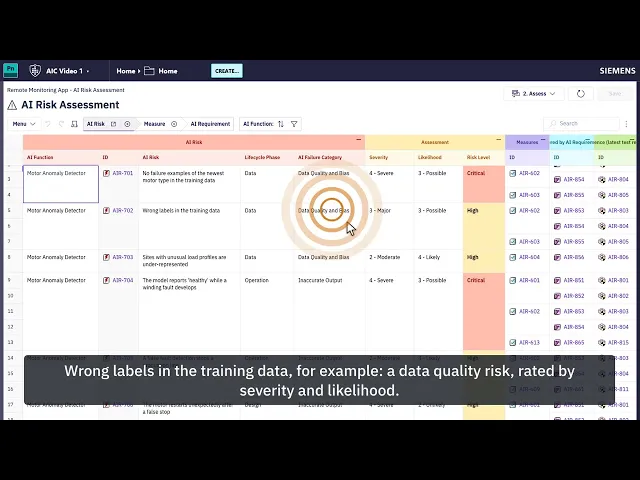
The AI Risk Assessment covers what can go wrong because a function uses AI: missing failure examples in the training data, wrong labels, a model that reports healthy while a winding fault develops. Each risk is rated for severity and likelihood, the risk level follows from the matrix, and the measures, their AI requirements and tests sit in the same row. Where an AI risk can lead to a hazard of the machine, it links to the safety hazards it could cause.

For a new risk, the Powersheet AI Assistant proposes measures that already exist in the project, each with its reasoning. Nothing changes until the engineer applies one.
Built to sit next to what you already run
Art. 9(10) of the AI Act lets the AI risk management be part of the risk management other Union law already requires, and the requirements are mapped to the matching ISO/IEC 42001 clauses, so a team with an AI management system sees what it already covers. The requirements, statuses and checks are Polarion configuration, and the sheets are Powersheet configurations that can be changed like any other.
What this demo does not do
It does not decide the class of your AI function for you, and it does not replace the conformity assessment. The ISO/IEC 42001 controls are worded in our own words, as the standard is copyrighted. Dates and obligations follow the AI Act as amended by Regulation (EU) 2026/1744; check them against the act before you rely on them.
Talk to us
If you want to see EU AI Act compliance and AI risk assessment on your own product, book a meeting or read more about Powersheet.