Traceability
Requirements Traceability for Automotive, Inside Polarion: Does the Trace Hold? | Nextedy POWERSHEET
Length
3:54
A braking controller goes to its ASPICE assessment in two weeks, and the assessor will ask whether the trace holds at every level. The coverage, counted from the links themselves, says two customer needs have no system requirement and fourteen system requirements have no test yet. This is how a systems engineer answers inside Siemens Polarion.
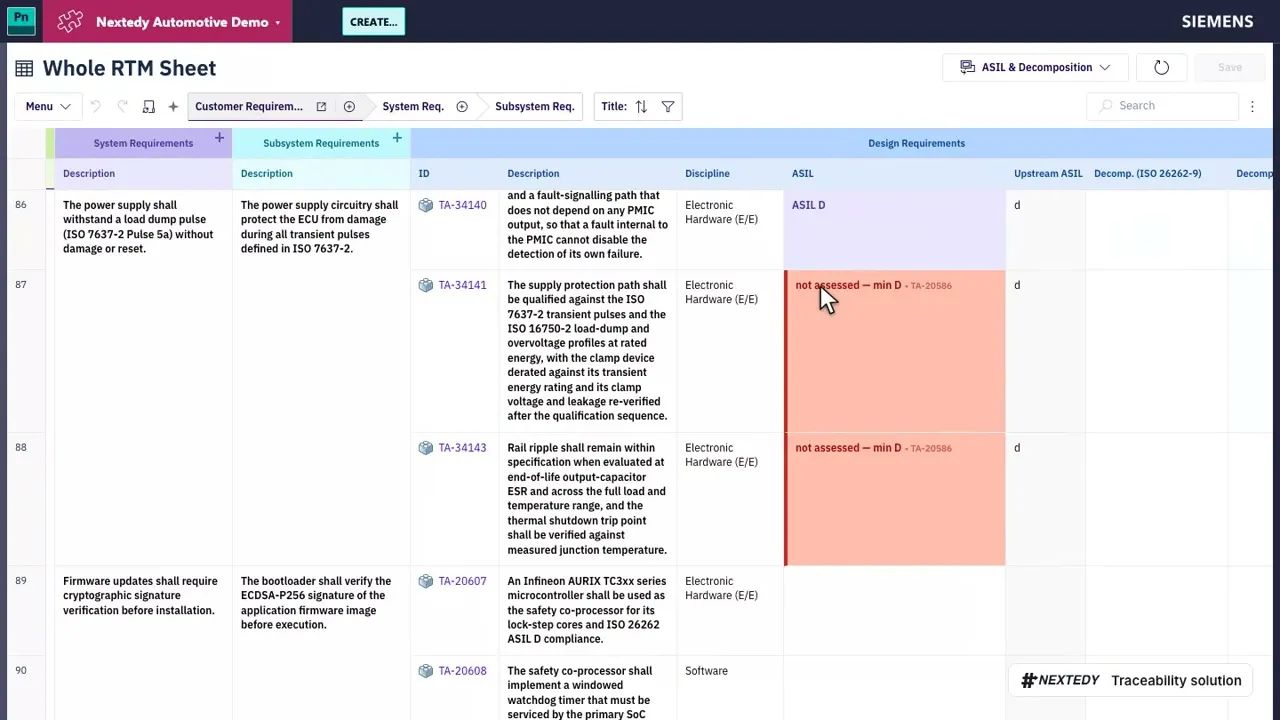
The trace opens as a Powersheet: customer need, system, subsystem and design on one sheet, a data-entry form, not a report. One customer need is followed down: functional safety compliance, eight system requirements, the one that says the controller must survive a load dump, the power input protection, and the design requirement that qualifies it, whose test cell is empty. A gap is white space. A safety-rating view checks the rule in the cell: no level set under a parent rated D is flagged, a sibling rated B with its decomposition recorded is not. A spreadsheet filter on the test column turns the sheet into the gap list nobody wrote.
The gap is fixed where it was found: typing in the cell finds the component transient immunity test of the supply input by name, the rating comes from a list, the flag clears, and one save writes both changes to the work item, where Polarion keeps the history. Then one of the needs with nothing under it, the standardized diagnostic interface: the toolbar offers only the levels the model defines, and one click creates the system requirement under it, with no parent to choose and no link role to pick. The coverage, moments later, counts one customer need fewer without a system requirement; nobody edited the page, the number moved because the link did. And every sheet is a configuration of levels, columns, views and rules that an administrator adds.
Standards on screen: ASPICE · ISO 26262.
Try it yourself: https://www.nextedy.com/try-now/traceability-automotive
Nextedy POWERSHEET for Siemens Polarion