Safety and Risk
Risk Management for Medical Devices, Inside Polarion: Current on Review Day | Nextedy RISKSHEET
Length
5:38
Two weeks before the periodic risk management review of an infusion pump, the risk manager has to know: is the risk file current, and what is still open? This is how it is answered inside Siemens Polarion.
Hazard analysis, design FMEA and process risk sit in one Polarion space, hanging off the device tree. The Nextedy ISO 14971 report reads the same records: two risks remain unacceptable after control, and the final verdicts agree. The hazard analysis opens as a Nextedy RISKSHEET, rated the way ISO 14971 rates a risk:
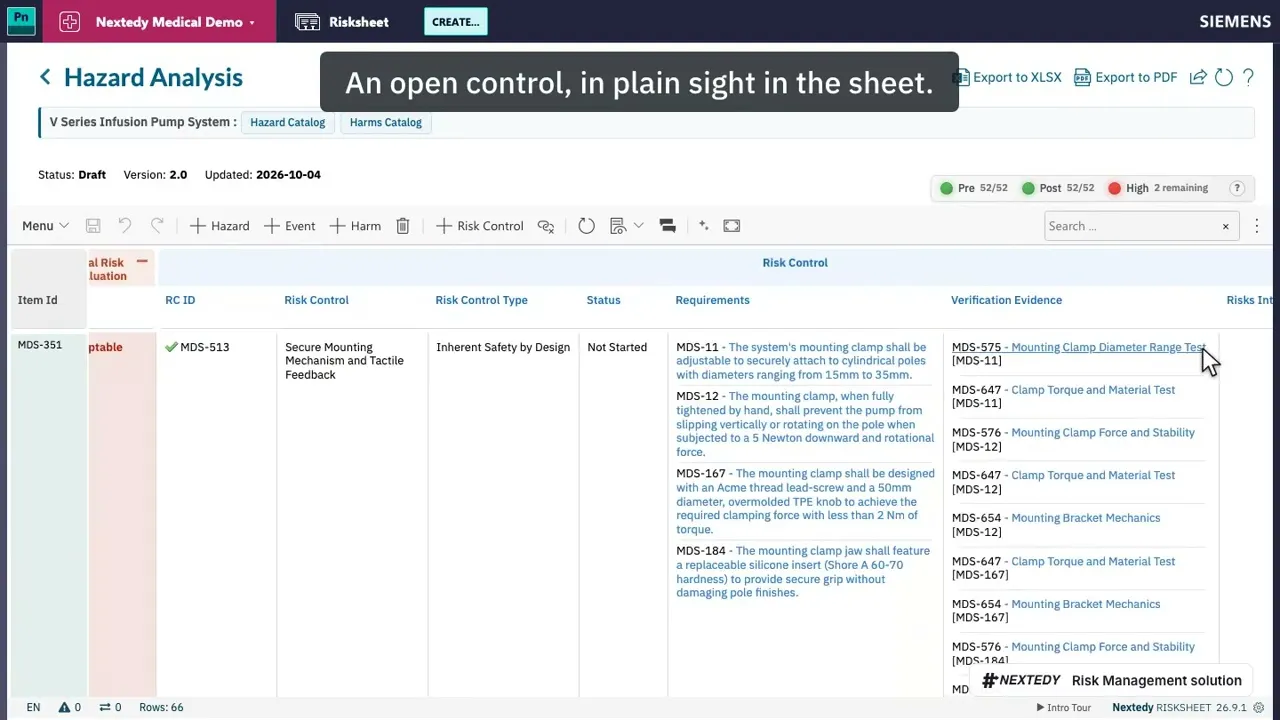
two probabilities and the severity of the harm. A new hazardous situation is added under the same hazard; the harm comes from the shared catalog with its severity, both probabilities are rated from the plan's own scales, and the risk is computed: unacceptable before any control. Then field data: complaints report three falls from worn pole clamps, so the first probability of the pump falling onto a patient is raised in the cell, investigation becomes unacceptable, and the reason is typed beside it. The work item's history keeps the old rating, the new one and the reason. Its control, a secure mounting clamp, is open in plain sight, with its requirements and tests on the same line, and the design FMEA of the pumping and housing subsystem points back to the risk.
In the residual step, a column filter finds the two unacceptable risks. One: a pump programmed with ten times the intended volume. The Nextedy AI assistant, grounded in the risk file's own data, proposes only controls that already exist, each with its reasoning; the engineer applies hard input range and dosing limits, lowers P1 with the reason, and records the benefit-risk decision the plan asks for in the investigation zone. The residual drops from unacceptable to investigation, the final verdict follows, and the report counts one unacceptable risk, not two. Compared with a Polarion baseline, the sheet shows each changed cell old over new, the added hazardous situation and the new reason. Behind the sheet, its template in the Nextedy RISKSHEET configuration editor: change it once, and every sheet built on it follows.
Standards on screen: ISO 14971.
Try it yourself: https://www.nextedy.com/try-now/functional-safety-medical
Nextedy RISKSHEET for Siemens Polarion