Safety and Risk
System Safety for Aerospace, Inside Polarion: Counted, Not Hunted For | Nextedy RISKSHEET
Length
5:13
Three weeks before the certification review of a flight control computer, every failure mode is rated before and after its control, and one is still unacceptable after mitigation. The review will ask about it. This is how the system safety engineer answers inside Siemens Polarion, with no spreadsheets to merge.
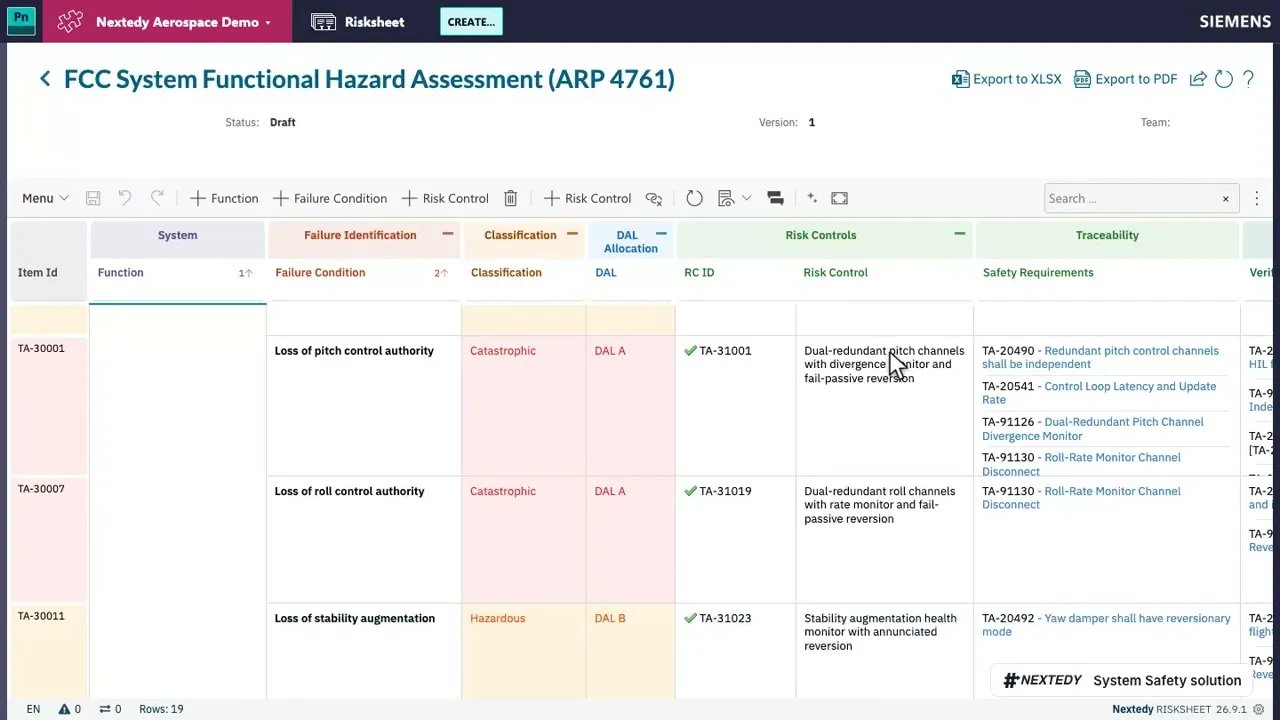
Failure conditions, failure modes and controls share one Polarion project, every analysis on the system tree, the functional hazard assessment at the top. It opens as a Risksheet: a data-entry form, not a report, where every row is a Polarion work item. A design change adds a failure condition, typed straight into the sheet; flight phase, classification and probability target come from dropdowns, and the design assurance level follows the moment it is classified. On an existing one, a misleading attitude display on approach, the probability target contradicts its own safety objective; the analyst tightens it in the cell, and the work item's history keeps who changed it and when. One view puts the chain on one line: losing pitch control at takeoff, level A, two independent pitch channels, the safety requirement that implements the control, and the test that verifies it.
One level down, the processing core subsystem FMEA analyses the same function. A column filter, as in Excel, leaves the one failure mode still unacceptable: a control law mode transition error with a random hardware cause, a single-event upset in memory. Its controls so far are verification activities, and a test cannot lower a hardware failure rate. The Nextedy AI assistant, grounded in the project's own data, proposes only controls that already exist there, each with its reasoning; the engineer applies a hardware measure the programme already owns, lowers the probability, and the sheet computes acceptable. Software design errors stay with development assurance, never a probability. The safety space then counts no unacceptable failure mode. The sheet compared with a Polarion baseline, with only changes on, shows the corrected target, old beside new, and the added failure condition. And the configuration editor opens on the acceptance rule: severity against probability.
Standards on screen: ARP 4761.
Try it yourself: https://www.nextedy.com/try-now/functional-safety-aerospace
Nextedy RISKSHEET for Siemens Polarion
https://www.nextedy.com/solution/functional-safety-aerospace