Traceability
Traceability for Medical Devices, Inside Polarion: Current on Inspection Day | Nextedy POWERSHEET
Length
3:32
Two weeks before a design-controls inspection of an infusion pump, the inspector will walk every user need down to the test that proves it. This is how the engineer who owns the trace answers inside Siemens Polarion.
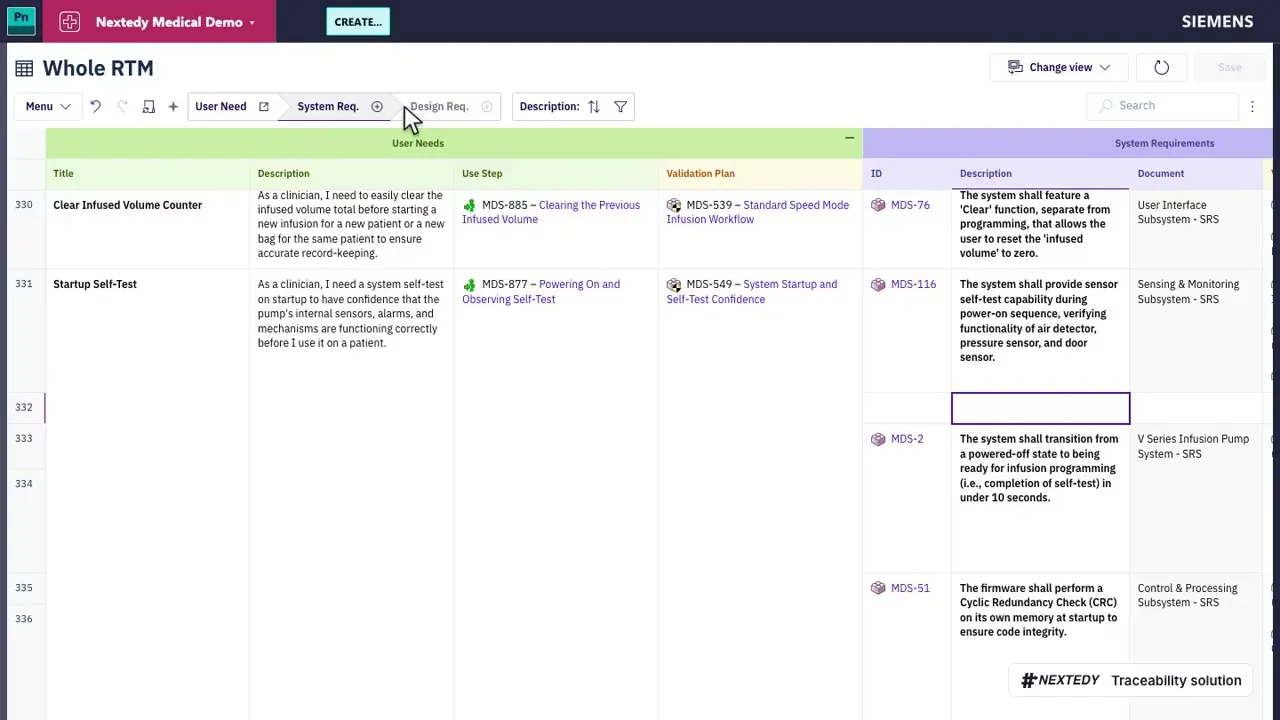
User needs, system and design requirements sit in one Polarion space, every specification hanging off the device tree. The coverage is computed from the links: thirteen design requirements still have no test. The trace opens as a Nextedy POWERSHEET: user need, system requirement, design requirement and their tests, left to right, over the live work items. One need, the startup self-test, is followed: a configured view fits its whole tree on one screen, four system requirements, each refined by design requirements with tests of their own. A new design input is created under the need with one click, already linked; the model decides the link and the specification, and the new requirement is saved as a work item inside the model.
The upper levels fold away, and a column filter shows the design requirements without a test as empty cells. One of them, the minimum font size of the display, is fixed in place: typing in the cell searches the live tests by name, and the display readability test now verifies it, the link saved on both work items.
The coverage reads twelve where it read thirteen. The risk file is a sheet on the same records, where the self-test appears again as the control for a hidden component fault: no export joins the two chains.
Sheets, levels, columns and views are configuration; an administrator adds the next sheet without code.
Standards on screen: FDA 21 CFR 820.30.
Try it yourself: https://www.nextedy.com/try-now/traceability-medical
Nextedy POWERSHEET for Siemens Polarion